Is your signage fit for purpose in the hybrid working era or are you missing an opportunity to use it to enhance brand-building and internal communications? Business Info looks at how one company is making the most of new print techniques to transform its clients’ use of internal and external graphics and signage
A major investment in a direct to surface printer is transforming possibilities for Cobal Sign Systems and its clients, including technology distributor, Westcoast. Cobal is turning signage from something purely functional into something ‘experiential’ that people can interact with visually and physically. Or, in the words of Cobal Marketing & Communications Executive Caroline Cross, something “akin to an art installation”.
Cobal makes internal and external signs and graphics for almost every requirement, from huge corporate logos at the top of 50-storey office buildings and illuminated signs in shopping centres all the way down to tiny number plates on office desks for asset tracking purposes, using all manner of materials to reflect clients’ varied brand values, from wood, metal and glass to acrylic wallpapers and even cardboard.
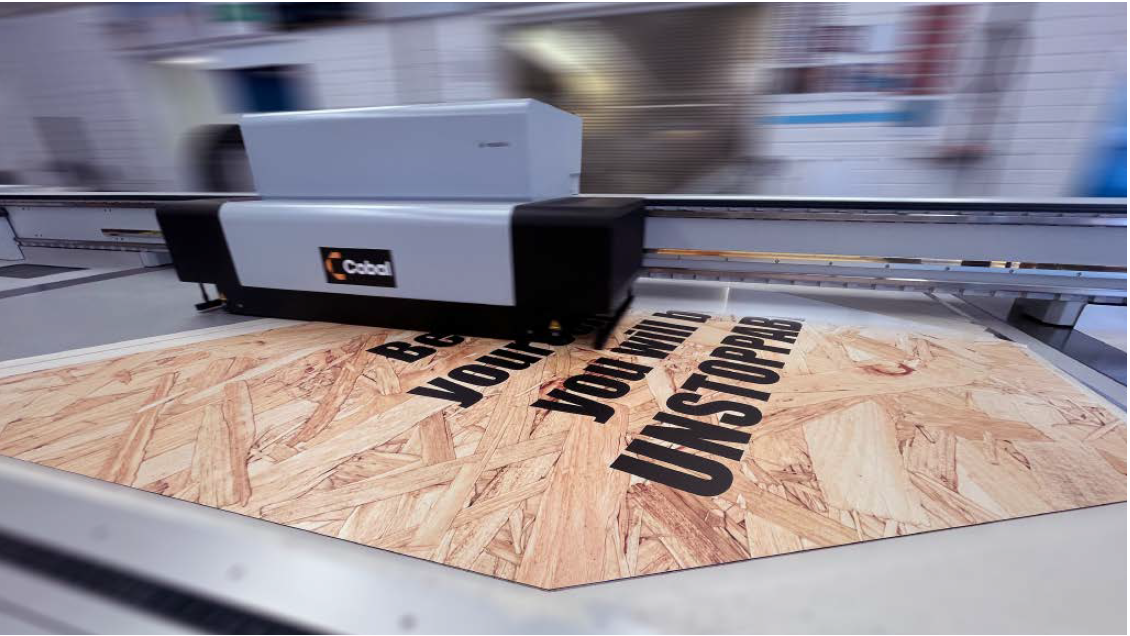
The addition of a custom-made flatbed printer to the company’s in-house production capabilities has not just enabled the Newbury based company to produce large format output on-demand but also given it the ability to create textured prints that are both physically and visually immersive. 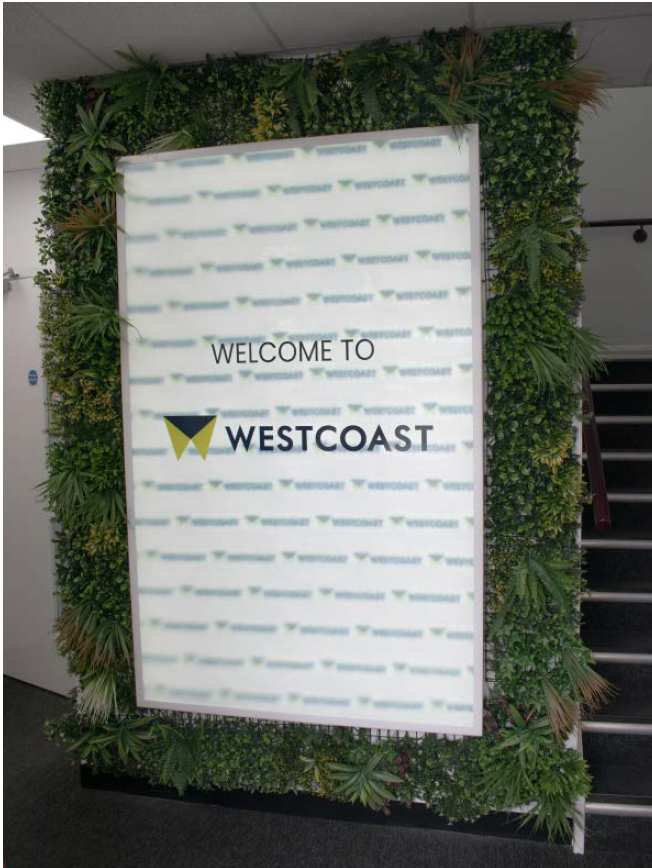
“It’s allowed us to do things that other people just can’t,” explains Managing Director Paul McGlone. “The example I often use is corridor wallpaper printed with a forest scene. You can run your hands along it as you walk, feel the bark every time you hit a tree and look up and see raindrops, printed with a layer of spot gloss, glistening on the leaves.”
Cobal’s new printer is an important part of McGlone’s strategy to bring all signage production and all employees back in-house and to focus on building long-term relationships with individual businesses who care about their staff’s working environment and the experience for visitors. “When I took over, we were subcontracting much of our production work and operating in silos with staff scattered around the country.
My mission was to strengthen the business, and the path to achieving that was to get bodies back in the building, to recruit people who want to work in an office and to bring technology back in-house.” McGlone says the company’s new printer is already paying for itself by enabling Cobal to do what he calls ‘the flat stuff’ – large format, direct to surface printing – in-house rather than through subcontractors, reducing costs and improving response times.
However, his intention was also to go beyond that and do something that no one else in the market is doing i.e. textured output, created by printing layer after layer of ink to give different heights across an image, as well as other advanced printing techniques, including clever optical effects that give the impression of moving images and 3D-like depths.
Cobal is revelling in the possibilities its new printer brings, steering clients in new directions and encouraging them to give the same attention to signage that they would to graphic design or interior décor, highlighting the role that internal and external signage plays in creating and reinforcing a brand identity and giving employees an inspiring working environment.
Innovative printing A good example is the work it is doing with the largest technology distributor in the UK, Westcoast. “Like most of the customers we work with, Westcoast came to us with an idea for their offices in Theale.
 We explained that we could absolutely do what they were looking for, but could add in some cool stuff too. We mocked up some images, elevating their idea to another level, and they loved them!” explains Cross. “We started out creating signage for a new office for Westcoast, but then, on a tour of the building, we suggested ways to add impact to the signage outside the main building and to make a stronger impression in the reception area.
They loved our truly innovative printing and the scope of our project has continued to grow as a result.” The highlight of this project is a standalone unit in the reception area – the first thing people see when they come through the main door of the building. It combines back lighting with a unique 3D depth effect that gives the impression that the Westcoast logo is projected out and floating.
“It’s very impactful and impossible to describe,” says Cross. In addition, Cobal has enlivened Westcoast’s new office areas, creating a busy, vibrant aesthetic with bespoke wallpaper featuring inspirational brand images and colour wraps around the pillars, while maintaining a unified look and feel that even extends to workpods fitted with name and number plates from the Cobal accessories range.
Thanks to Westcoast’s openness to new ideas, they have been a dream client. McGlone is quick to point out, Cobal is also a dream supplier, not least because of its continued investment in new technology.
“We’re on the same page. The visuals that Caroline created inspired them to think beyond the basics and expand their scope. With Cobal, they collaborated with an organisation that not only has vision but also has the capability to bring that vision to life.”
Sustainable signage Innovative printing techniques are not the only area in which Cobal is gaining a competitive edge. It is also seeking to change customer perceptions around sustainability.
“I’ve been doing work with signage companies for years and, to put it bluntly, the conventional attitude is ‘you get what you get; it’s just a sign’. People have this mindset that there’s no place for sustainability in signage.
My great good fortune is having people within this business who are receptive to doing things differently, like putting sustainability at the heart of our proposition,” explains McGlone.
In addition to its investment in new machinery, Cobal has changed its ink systems (it now uses Green Shield-approved inks) and its choice of materials, which has involved changes to manufacturing processes because some sustainable materials need to be handled and processed in a very different way.
It has also adopted a ‘whole life’ approach to signage, from its conception when working with architects and designers to its installation and maintenance when in use, all the way through to making sure signs end up in the right reuse or recycling path when they are no longer needed.
“That’s very unique in the signage industry,” says McGlone. He is now taking this to the next level and introducing maintenance for that ‘whole life’ period so that once a quarter or once every six months Cobal will inspect a customer’s signage and carry out repairs and preventative maintenance to keep it looking as intended and to ensure it continues to comply with health and safety regulations.
“In the past, like others in this industry, we have probably been guilty of completing a job and then quickly moving on to the next job and the next client, to the point where if a salesperson called a company and they said ‘We’ve already got signs’, their default response was to go ‘OK, thanks’ and hang up. That’s not how we do business. We’ve got much more to talk about. That’s why we’re shouting about our capabilities – to get people interested in how they can use signage to project their brand identity, but also to create an inspiring workplace and enhance communication with their employees.”
To speak to Cobal, about your signage requirements, please call 01635 570600 or visit https://cobal.co.uk