Good communication is the cornerstone for any business, but it can be hard to keep up with the most effective ways to achieve this – especially with hybrid and remote working reinventing the workplace. Businesses are having to adapt quickly to keep up with a whole new set of telecommunication technologies and employee expectations.
To stay ahead of the curve, many businesses are turning their attention towards new IP-based technologies and Unified Communications Platforms, which can enhance the flexibility and mobility of their employees. However, there are still many businesses that are yet to realise the host of benefits that these new technologies can offer.
Hybrid working – here to stay
An ONS survey, which ran for one week between April and May 2022, found that 38% of working adults had worked from home at some point over that week, compared to just 12% in the same week before the pandemic.
These findings show how the recent shift to hybrid and flexible working, that first gained momentum during the pandemic, has sparked a change in the mindset of employees, and consequently, the organisations where they work. The data not only conveys how employee expectations have changed, but also brings to light how quickly businesses need to adapt to avoid potentially losing staff.
As also highlighted by research from Microsoft and YouGov, organisations who choose not to offer hybrid working put themselves in real danger of not only reducing employee engagement, but also limiting their ability to attract and retain workplace talent. The research revealed that 51% of UK workers who were able to combine working from home and traditional office work said that they would consider leaving their company if this level of flexibility wasn’t allowed to them.
It’s never been so vital for businesses to recognise the needs of their employees and support their teams with the appropriate technology to facilitate seamless hybrid, and ideally wireless, working.
What are the benefits of adopting new telecommunication technologies?
There are a host of benefits that businesses and their employees
can realise by using new IP-based telecommunications systems and corded or cordless SIP phones.
Firstly, new IP-based technologies are cost-effective. Despite common misconceptions suggesting that migrating to a new telephony infrastructure might be costly, keeping up with the latest technologies can deliver huge cost savings in the long term. New IP-based telecommunications will already save you money in the mid-term compared to traditional landline telecommunications systems
– especially if your business is making a high volume of long-distance and international calls. This is a practice which has grown rapidly since the start of the pandemic, with workforces more dispersed than ever.
Secondly, investments in the latest technologies are secured: new, best- in-class IP-based telecommunication platforms and endpoints are more integrated in the whole ERP and CRM infrastructure of businesses than legacy systems, helping to increase productivity. Furthermore, their firmware is frequently updated and patched – which means that after the initial investment, your equipment will keep pace with the newest threats and won’t become quickly outdated, allowing you to effectively future-proof your business for years after the purchase.
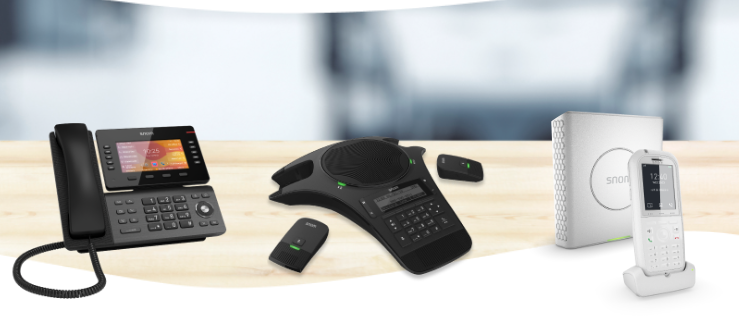
In addition to this, products such as Snom’s Digital Enhanced Cordless Telecommunications (DECT) IP devices or its new business desk phone, the D865 with Wi-Fi, allow businesses to reduce cabling costs and benefit from a simplified setup process. With employees now keen to work from more than one location, it’s critical for businesses to ensure that their telephony system can manage the new mobile employee to a high standard by granting access from anywhere to the same telephony services and resources workers enjoy at their desk in the office. Through our DECT range, we’re able to provide businesses with the consistent reliability, high-quality audio and security that they’re looking for.
Finally, the increase in concern around the rise of telephone tapping has resulted in a higher demand for secure phones. As laws surrounding the handling of the transmission of sensitive data grow stricter, organisations who want to benefit from the higher productivity and mobility granted by modern UC platforms need to adhere to several different laws, principles, and obligations.
Current state-of-the-art telephony solutions come with strong encryption mechanisms, which IP endpoints must support to be able to connect to the PBX, receive their configuration parameters via auto provisioning and deliver high-end telephony features.
For high-quality devices made by premium manufacturers, the endpoints themselves include additional security features to avoid eavesdropping, session hijacking, unauthorised phone use and similar incidents.
Businesses who take the step towards this wireless future – enhanced by modern communications – can expect to benefit from increased security, enhanced employee mobility, and much more.
From SOHOs to large enterprises
Small and Home Offices (SOHOs) such as consultant offices or private practices, and small-to-medium enterprises (SMEs) such as medical practices, financial services and law firms, are prime examples of businesses that can reap the benefits of wireless working.
With research showing that 6 in 10 SMEs now prefer hybrid working to the traditional working week, businesses must ensure that their equipment aligns with the needs and expectations of their employees. The needs of hybrid and remote workers certainly vary, but an IP telephony option that allows flexibility and enhanced employee mobility through flexibly deployable phones can really make the difference in small and home office spaces.
The Snom M100 SC DECT is perfect for these kinds of working environments. The base station can be used for stationary and cloud-based telephony, enabling small and home offices to benefit from a professional and flexible solution which supports eight SIP identities, six simultaneous calls and up to ten Snom M10 SC DECT-over-IP phones. A highlight of the Snom M100 SC for SMEs is its ability to connect to the telephony system in the parent company via VPN. Not only does this increase the security of telephone calls, it also provides the user with all the functions of the company headquarters (shared address book and much more).
For larger enterprises, such as those in the manufacturing industry or the public sector, a big benefit of adopting new IP technologies is how scalable they are. Businesses can connect their teams irrespective of their location in one central, manageable communication hub. In addition to this, they simply add or remove users from the system whenever suits them – allowing their office equipment to grow simultaneously with their business. Another key benefit for larger enterprises is that internal calls are free – and as we see more and more employees moving away from their traditional desks, communicating efficiently whilst on the go is a great luxury that new IP technologies can grant businesses.
The Snom M900 DECT Multicell Base Station is also a great solution for many large enterprises. The integrated DECT manager, housing state-of-the- art technology, can enable individual installations comprising up to 1,000 base stations and up to 4,000 handsets. Thanks to the M900 base station, device maintenance can also be carried out easily and efficiently. Each base station can wirelessly send software updates to connected handsets, greatly reducing the workload for the IT department – and subsequently maximising business efficiency.
Large offices which have no fixed workspace and rely on hot desking benefit the most from this kind of solution, as well as from Snom’s WiFi desk phone, the D865.
About Snom
With over 10 million devices installed and offices in the Benelux, United Kingdom, France, Italy, Russia, Spain and South Africa, Snom Technology is a globally recognised manufacturer of IP telecommunications solutions for professional use.
Founded in 1997 in Berlin and part of the VTech Group since 2016, the company continues to design and develop its products in Germany and attaches great importance to quality and safety. Snom uses its 25 years of experience and innovative strength to tackle new mobility challenges and increase digitalisation with cutting- edge technologies that are adapted to all communication needs
and environments.
The company’s worldwide sales network includes many renowned distributors and over 10,000 specialist dealers. They benefit from a dedicated partner program as well as personal remote and on-site support services that, alongside its leading technology, contribute to Snom’s outstanding international reputation.