You’re in a boardroom squinting at a screen at the far end of a long table unable to see what’s being discussed; you’ve joined a meeting remotely, from home, but can’t hear what the CEO is saying; you have an important meeting with a potential client but the meeting room camera is broken; you need to finish your report but there’s nowhere quiet to work.
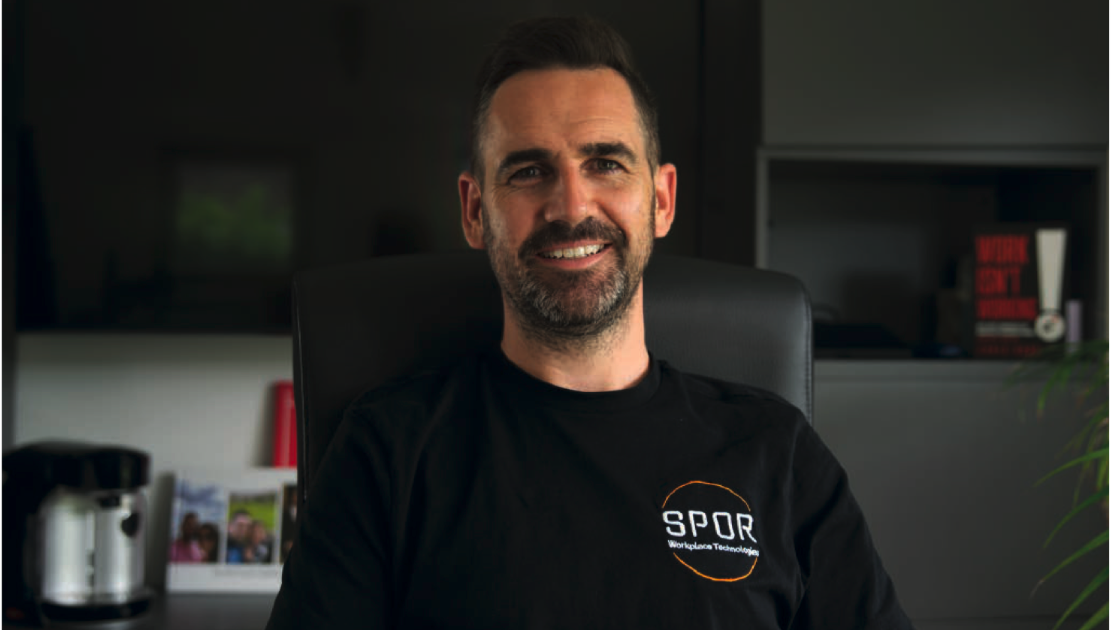
If these scenarios sound familiar, it is because they are all too common – so much so that Chris Gore, co-founder of specialist AV integration business SPOR Group, has written a book on the subject called Work Isn’t Working.
His thesis, spelled out in the first half of the 118-page book, is that major investments in meeting room technology and digital workplace solutions often fail to
deliver the desired results because the providers and integrators of those solutions are not consulted early enough in the process, i.e. at the design stage, and are then not retained to monitor and manage the solutions once they have been deployed.
Because AV experts are often brought in once the office floorplan has been defined, walls erected, lighting and cabling installed, furniture brought in, it can be too late to make the changes needed to get the best out of new meeting room technology, resulting in compromise and a sub-par user experience.
In many instances, the outcome is not a collaborative, productive working environment, but unhappy employees, lost business and over‑burdened IT departments.
DITAM framework
In the second half of Work Isn’t Working, Gore explains how businesses can avoid these mistakes by adopting a DITAM framework. Standing for Design, Integrate, Train, Asset Manage and Monitor, this gives CIOs, IT directors, facilities managers and business leaders a practical model for improving technology adoption, strengthening accountability and ensuring workplace systems continue to deliver value long after installation.
Chris Gore, who co-founded SPOR Group with business partner Christopher Spence in 2019, says DITAM has evolved over five or six years based on mistakes made and lessons learned when the two started out.
“I have a military background, so my mind is very process-driven. I like everything to happen in order, and if something happens and there isn’t a process that sits underneath it, we create one because my goal is to achieve success by following a repeatable model,” he explains.
“We started out installing screens and early on recognised where we had challenges and what we needed to do to overcome them – ‘We didn’t design this properly, so before we integrate, we need to get the design right, so the integration becomes much easier’.
That’s the ‘D’. Then, we found that clients sometimes complained that service response times were quite slow. ‘Is there a pattern to the callouts? Well, yes, the pattern is users haven’t been trained properly’. That’s the T. We need to train the users, and train for the lowest common denominator, an office manager who doesn’t know technology. That’s how DITAM evolved.”
Evolving capabilities
For this reason, DITAM also reflects how SPOR Group itself has changed and expanded its proposition and capabilities since 2019.
“In our space, there’s really five big AV companies and they all tender for £3 million, £4 million, £5 million projects. We saw a gap in the market, where companies with a budget of £250,000 weren’t necessarily being looked at because the large AV companies were too busy doing £4 million projects. Down at that £250,000 level, companies were having to bring their requirements in-house, creating another job for their IT team. We created SPOR Group to target that market,” says Gore.
“Our basic premise in 2019 was standard meeting rooms, doing projects of up to about £250,000 and rolling out standard meeting rooms with the same technology.
That was our business plan. Since then, we’ve grown and become well respected for doing the full design and build of AV projects. We still do standard meeting rooms with video conferencing capabilities, but we also do boardrooms, we do large LED rollouts, we do experiential projects, we do auditoriums and town hall spaces. Whatever we do, the key is getting early engagement with clients and architects, doing the AV design alongside those people and doing the integration as the project progresses.”
Service contracts
Today, SPOR Group employs 30 people and has over 200 clients. Crucially, it also manages more than 1,500 meeting rooms across the world – the A (asset management) and M (monitoring) of DITAM.
“In the early days, when we were just installing standard meeting rooms, we’d basically say to a client If there’s any problem in your room, give us a call and we’ll come and fix it’. That was the service contract.
We’ve now progressed and matured as a company and offer remote monitoring and management.
We can onboard client’s devices onto our proprietary platform (SPORTrack) and see the status of each one, enabling us to proactively monitor those devices and make an intervention whenever (and wherever) an issue is detected.”
Not all customers want proactive monitoring – some are nervous about third parties monitoring their devices – so SPOR also offers reactive service contracts with defined SLAs, putting the onus on the customer to call a helpdesk when they have a problem. Gore estimates that 99% of customers choose a service contract, with a 50:50 split between the two options.
Hybrid working
He adds that a service contract, in fact the whole DITAM model, has become more important with hybrid working, the success of which depends on seamless, easy, reliable collaboration.
“A lot of leaders are trying to work out the optimum working model for their business, whether that’s fully remote, a hybrid model or having everyone back in the office full-time. Whatever choice they make, they need to get the technology right. If you have a hybrid policy and you’re asking your staff to commute and spend £50 on the train, when it’s really hot and there’s no air conditioning on the tube, they’re already stressed when they arrive at work.
If they then walk into their first meeting at two minutes to nine, press start on the camera and the camera doesn’t work, completely messing up their client meeting, pitch or interview, your hybrid policy will have failed.
Your employee will walk out of that meeting thinking ‘I’ve just spent two hours on a train. I’m hot, I’m bothered and I’ve spent £50 of my own money when I could have started my meeting at home and it would have worked’. Proactive monitoring and maintenance is vital for hybrid working because it ensures the meeting room technology will work when your people come into the office.”
Monitoring meeting room usage will also help organisations gauge the success of a hybrid working policy and identify areas where things aren’t working as well as they should. If Fred books the 12-person boardroom at 2 o’clock every Wednesday because he needs peace and quiet, you need to be able to measure that. Gore estimates that 70% of SPOR’s business is generated by office moves.
“We work alongside our clients and design their office move technology stack. We provide all the equipment, we install it, and we onboard it onto our SPORTrack asset management and remote monitoring system.
The other 30% is made up of retrofit installations when clients will essentially say ‘This stuff’s five years old. It’s starting to get a little bit glitchy. Can we consult with you on a proposed solution?’. We retrofit everything for them, decommission everything, recommission everything and get rooms back up and running with brand new kit.”
Gary in a van
Quite often, clients will come to SPOR after a bad experience with a less capable provider.
“With smaller projects, businesses can end up hiring a freelancer, a ‘Gary in a van’, who doesn’t have a project management overlay, doesn’t have an engineering stack to be able to put the engineering designs together.
They’re essentially a freelancer who might buy a few screens and install them. The trouble is, once Gary’s installed those screens he’s gone, and when the display breaks he’s nowhere to be seen. He’s on to the next job. If you’ve ever tried to get back in touch with a freelance plumber, you’ll know the scenario.”
Gore admits that in its earliest days, SPOR too was a ‘Gary and a van’ operation, before its prospects were transformed by DITAM.
“Once we started deploying the DITAM model and we articulated that to our salespeople and we integrated it within the business, we were much more successful.
Our message is: we will design, we will integrate, we will train.
We’re now very well established as a design and build company for AV.”A design and build company with big ambitions.
“One of the things we’re looking to do is acquire other companies that fit the individual letters in that DITAM model. I’m just about to sign off on our first acquisition that fits within the ‘D’. Then we might look to acquire companies covering the ‘I’, like HVAC, CCTV, access control, so that we can become a workplace group as opposed to just an AV company,” explains Gore.
Watch this space.